



A real estate CRM should help an agent or brokerage respond to inquiries, track meaningful conversations, organize property preferences, and maintain relationships beyond closing day. It should not be confused with a guarantee of listings or a substitute for the agent’s judgment. Buyers, sellers, renters, and referral partners follow different journeys, while teams must coordinate ownership and avoid sending contradictory messages. This guide explains how to choose and configure a real estate CRM, maintain data quality, establish responsible follow-up, evaluate integrations, and measure useful outcomes for a U.S. real estate business.
Design distinct journeys for buyers and sellers
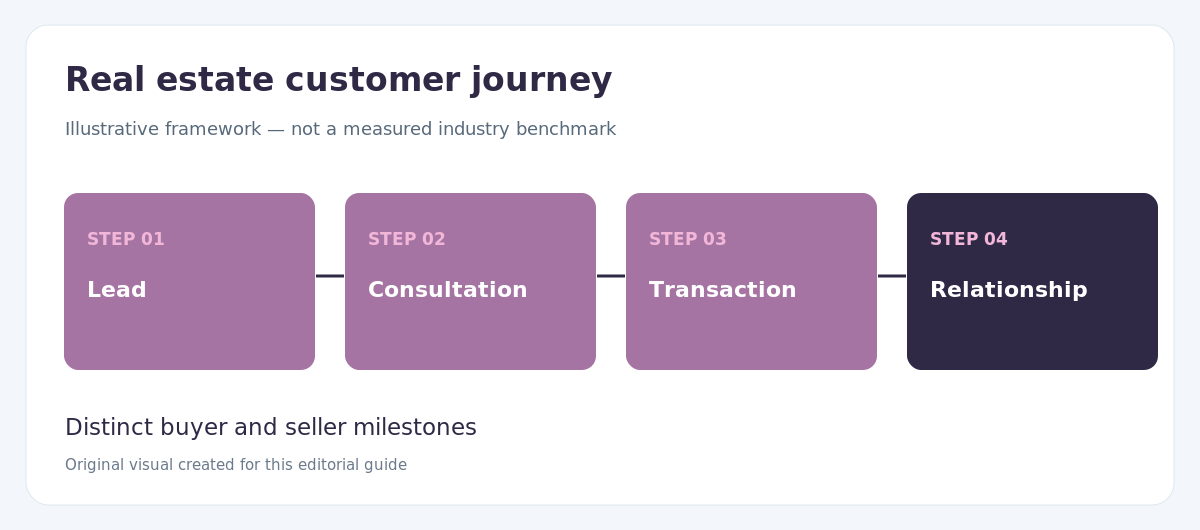
Buyer records should capture criteria that actually guide work: target areas, price range, financing status where appropriately shared, timing, key decision-makers, preferred communication, and next agreed action. Seller records may need property address, estimated timing, marketing preparation tasks, listing agreement milestones, showing feedback, and transaction coordination. Keep personal or sensitive details only when needed and authorized. A generic pipeline that mixes every type of inquiry often produces unclear dashboards and irrelevant automations.
Define lifecycle stages based on observable events. A buyer might progress from inquiry to qualified consultation, active search, property evaluation, offer, contract, and closed; a seller may move from evaluation to signed listing, active marketing, offer review, contract, and closed. Include closed-lost or paused outcomes rather than keeping inactive contacts perpetually labeled active. The CRM should distinguish a signed agreement from a verbal expression of interest.
Capture lead source and response without sacrificing accuracy
Inquiries may originate from a brokerage website, referrals, portals, open houses, social media, and direct calls. Record the source when the inquiry is created and avoid overwriting it whenever a contact later clicks a campaign email. Route inquiries to an available person with a clear ownership policy. If the assigned agent does not respond within the brokerage’s chosen service target, use an escalation task rather than having multiple staff send competing automatic messages.
Measure first meaningful response rather than only automatic acknowledgment speed. A bot may confirm receipt instantly, but the prospective client still needs a relevant human follow-up. Record communication preferences and any applicable permission basis, particularly where marketing texts and calls are involved. Rules for these channels can be complex; do not assume that supplying a phone number on one form is unlimited consent for every future campaign. Obtain appropriate legal guidance for outreach practices.
Use reminders to maintain real relationships
Useful automation includes tasks after showings, reminders about buyer-requested updates, milestone checks during escrow, and planned post-closing contact where appropriate. The goal is to prevent missed commitments, not send a generic drip sequence to everyone. Segment by actual relationship and stated interests: a buyer actively comparing properties needs different information from a homeowner who closed last year. Let agents pause messaging easily when personal circumstances or negotiations call for discretion.
Keep a history of what was discussed and promised. An appointment reminder should reflect the current time zone and appointment status; a canceled showing should not trigger an enthusiastic post-tour email. If using email templates, allow personalization that is truthful and review customer-facing messages. Respect unsubscribe requests and ensure suppression data synchronizes between the CRM and any marketing platform.
Evaluate property and transaction integrations carefully
A real estate CRM may connect to website forms, listing feeds, showing tools, electronic signature, transaction management, email, and analytics. Confirm whether the desired connector is native, a paid third-party service, or custom work. Listing and MLS-related integrations can involve local data access terms and rules, so verify permitted uses with the relevant provider rather than assuming a vendor’s demo covers your market. Prioritize reliable information and permissions over a long catalog of integration logos.
Transaction coordination should preserve key milestones, responsible people, document locations, and client commitments. Avoid storing highly sensitive financial documentation directly in unrestricted CRM notes when a properly controlled transaction system is more appropriate. Test the handoff when a deal changes agent or status. For brokerages, ownership and visibility between individual agents and the organization should be defined contractually and technically before records are imported.
Build a useful brokerage dashboard
A practical report might show new inquiries by source, lead response time, consultations held, active buyers and sellers, offers submitted, transactions under contract, closures, and clients needing a next action. Define counts precisely: “lead” should mean a unique relevant contact or inquiry according to a published rule, not every repeat form submission. Distinguish volume from conversion quality, and compare sources using equivalent time windows and sufficient sample sizes.
Avoid ranking agents solely by activity counts that are easy to inflate. Review whether the CRM helps agents provide useful customer communication and accurate transaction updates. Track stale records and incomplete handoffs as operational exceptions. A manager should be able to answer which clients need attention without reading private notes unnecessarily or treating the CRM as an indiscriminate surveillance tool.
Choosing software: an agency and brokerage checklist
For an individual agent, prioritize speed, mobile use, contact organization, follow-up tasks, website lead capture, and easy export. A growing team may need routing, shared pipelines, role restrictions, transaction integrations, and reporting. A brokerage may add office-level access policies, ownership reassignment, compliance processes, and consistent templates. Ask vendors to show the exact edition and seat structure being quoted, including which integrations cost extra. Consider whether occasional transaction coordinators require full paid accounts.
Demo with a fictional buyer inquiry and seller inquiry. Import each once, change assignment, document a consultation, schedule a showing, record a paused contact, and create a transaction handoff. Test opt-out handling and what happens when an agent leaves the brokerage. Review contract renewal, data ownership, export methods, and the cost of scaling. Buying a specialized label without confirming workflow fit can be more expensive than selecting a flexible general CRM configured well.
Illustrative workflow: from inquiry to post-closing
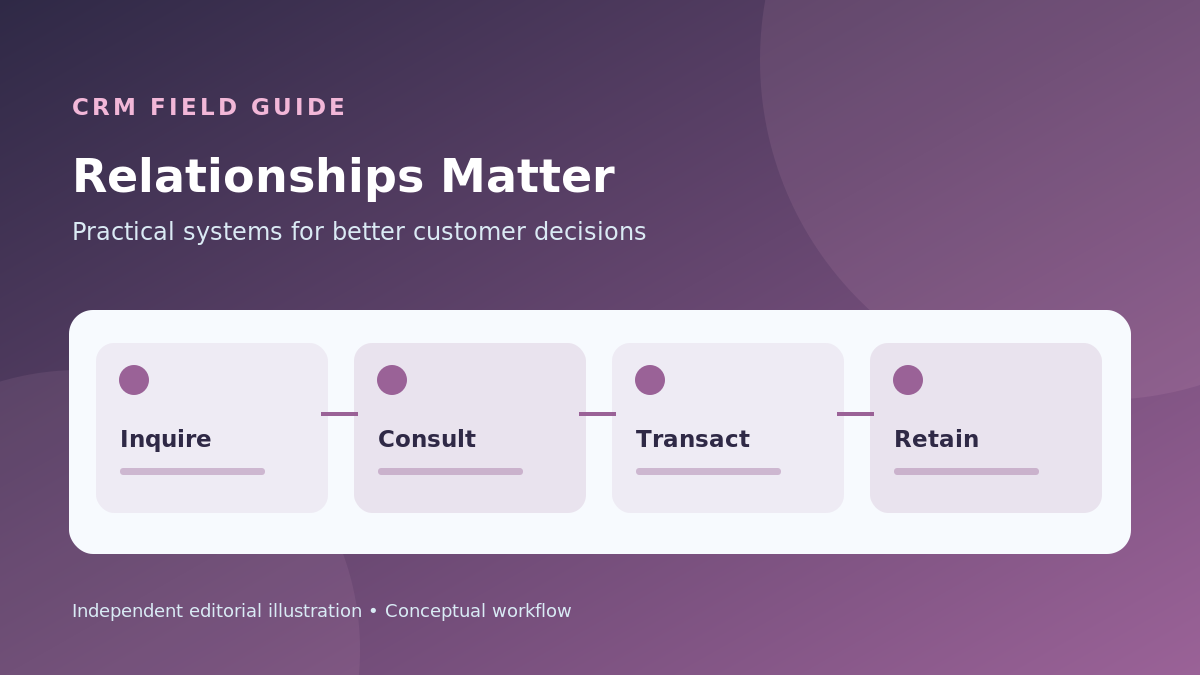
Imagine a buyer who submits a form about a home but has not yet discussed financing or timing. The CRM records the inquiry, source, contact preference, and assigned agent. It schedules a prompt human response, not an automatic “qualified buyer” status. After the consultation, the agent records the agreed search criteria and the next appointment. A signed offer and subsequent contract trigger controlled transaction tasks. When the sale closes, relevant customer service details are retained according to the brokerage’s policy.
Each stage requires a verified event and named owner. The process reduces forgotten handoffs while retaining professional discretion. A realistic performance assessment checks response reliability, agreed next actions, transaction coordination, and customer outcomes. A CRM cannot compensate for inaccurate listing information, poor advice, or weak market knowledge; it should make the agent’s professional work easier to coordinate.
Data hygiene and responsible outreach
Set rules for duplicate household contacts, shared family email addresses, referral attribution, and clients represented by multiple agents. Avoid indiscriminate merges that erase important relationships or communication preferences. Keep historic transactions separate from active sales opportunities, and make aging policies clear. Secure exports, respect retention requirements, and be thoughtful about uploading photos of identity or financial documents into ordinary contact records.
Review commercial email practices against the FTC’s CAN-SPAM guidance and assess other applicable calling, texting, privacy, and real estate rules with qualified advisers. Store the source and scope of communication preferences and make it easy to honor them across connected systems. A growing contact list has little value if the people in it cannot trust how their information is used.
Maintain long-term relationships without indiscriminate campaigns
A property transaction may end while the client relationship continues. A CRM can schedule a relevant check-in, track a referral made voluntarily, and help the agent remember important non-sensitive preferences. However, the usefulness of follow-up depends on timing and relevance. A person who requested a short-term rental does not necessarily want monthly homeowner marketing. Keep channel preferences and the reason for outreach visible, allow easy pauses, and avoid assuming every past transaction authorizes endless promotional messaging.
Review lead-source performance using meaningful outcomes and comparable cohorts. A channel that produces many unqualified inquiries may demand more staff time than a smaller referral source. Calculate cost per useful consultation or signed client relationship when reliable data exists rather than celebrating gross lead volume. Record attribution limitations where prospects interact with several sources. Decisions should reflect actual customer outcomes, not a dashboard optimized to make a marketing channel look busy.
Broker-owner review before implementation
Agree on who controls records, how transfers between agents are handled, which details brokers need for oversight, and what happens when a customer works with multiple agents in the office. Make these policies consistent with agreements and applicable legal responsibilities. Test export and reassignment before importing the entire contact database. A small investment in governance prevents disputes and preserves continuity when an agent is unavailable at a critical transaction milestone.
Frequently asked questions
Do solo agents need a specialized real estate CRM?
Not necessarily. A straightforward CRM can work when its lead capture, reminders, mobile experience, and relationship history fit the agent’s process. Specialized integrations are valuable only when they are available in the relevant market and actually used.
Should buyers and sellers share a pipeline?
They can share a contact database but often benefit from distinct sales journeys and reporting. Their milestones and handoffs differ enough that one generic stage list may reduce clarity.
What should happen to leads when an agent leaves?
Establish ownership and reassignment policies before deployment, subject to applicable agreements and law. Revoke access promptly, preserve legitimate business history, and assign a responsible person for active client commitments.
Is automatic follow-up always better?
No. Timely, appropriate communication is better. Use automations for reminders and truthful acknowledgments, with clear controls for consent, inaccurate data, and situations requiring a personal response.