
Artificial intelligence is increasingly packaged inside customer relationship management software, but “AI-powered” can describe very different functions: summarizing a call, drafting a follow-up email, recommending a next action, searching a knowledge base, or predicting the likelihood of a deal closing. Each has different data requirements and failure risks. For a U.S. organization evaluating AI CRM capabilities, the most valuable decision is to connect a specific task with measurable outcomes and governance. This article examines realistic use cases, human oversight, privacy considerations, pilot design, and procurement questions without assuming an AI label automatically produces better customer relationships.
Distinguish assistance from autonomous action
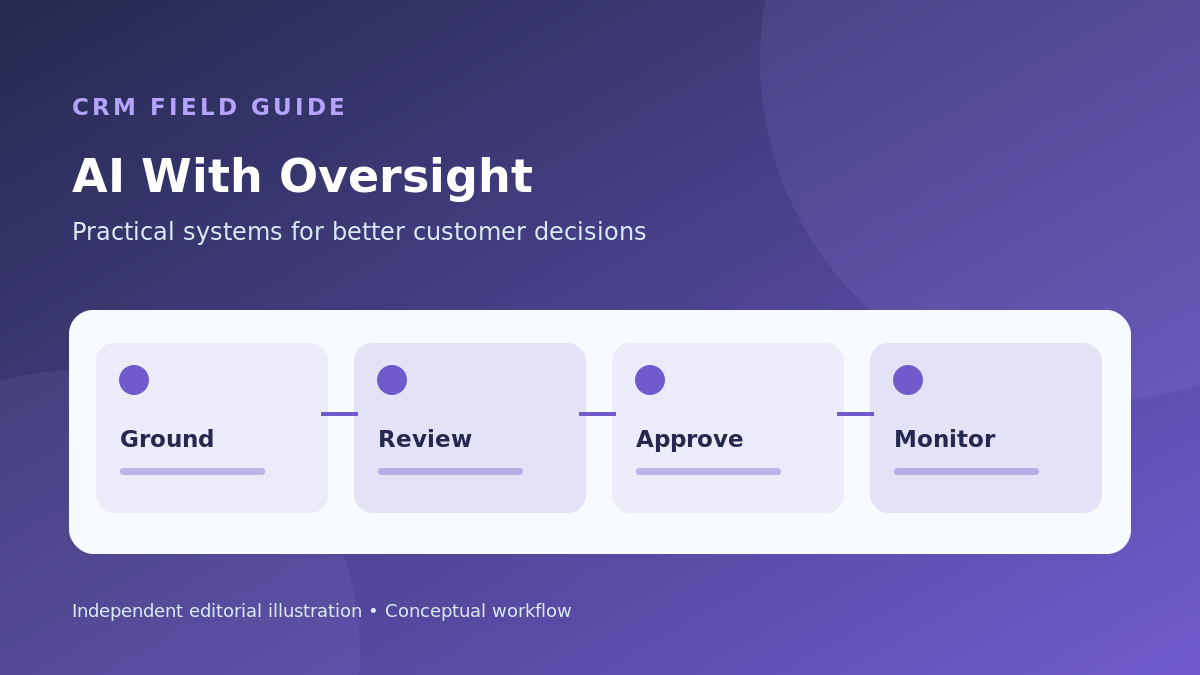
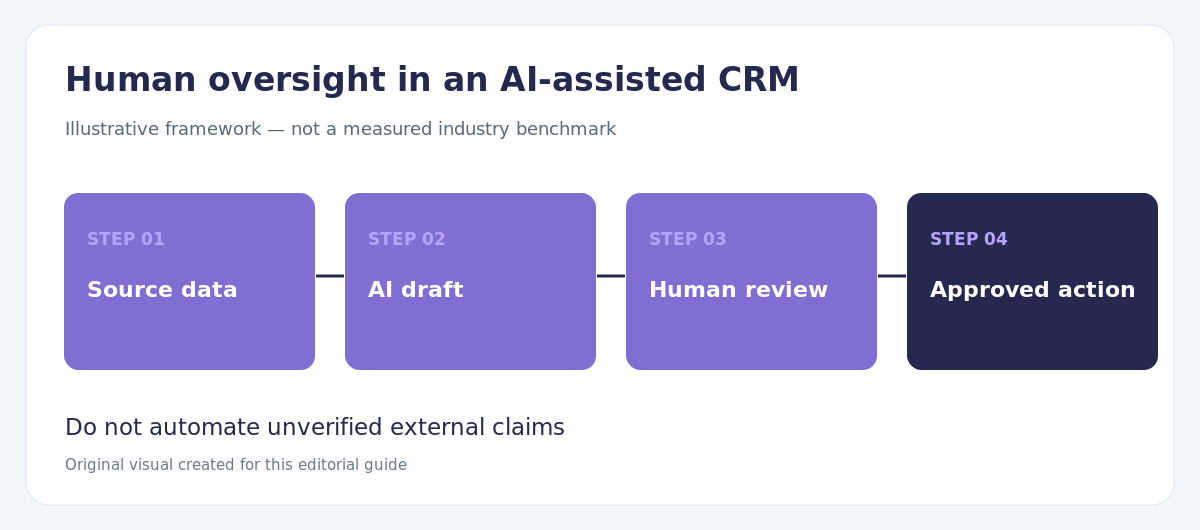
Assisted AI prepares information for a person to review: a meeting summary, a recommended next step, or a draft email. Autonomous or agentic features may act through connected systems, updating records or contacting users according to defined permissions. That distinction matters more than the sophistication of the demo. An inaccurate summary can be corrected before saving; an inaccurate automated message may reach a customer before anyone sees it. Design approval thresholds around consequences, not merely technical capability.
Inventory which features use generative language models, statistical scoring, deterministic rules, and external data enrichment. Ask whether suggested facts are grounded in the account record and how the system shows its evidence. A salesperson should be able to inspect the source meeting notes behind a summary or the deal fields behind a recommendation. Avoid publishing AI-generated claims about prices, contractual promises, product capability, or legal obligations without accountable human verification.
Good initial use cases for sales and service
Meeting summarization can reduce manual note-taking when recording consent, speaker attribution, and review processes are properly handled. Drafting a follow-up task from a documented customer commitment can help maintain consistency. Search across approved sales enablement resources can help representatives find product information, and a service assistant can surface relevant support articles. Predictive signals can help teams identify neglected opportunities, provided the underlying records are sufficiently reliable and the model is calibrated to their business.
Start with activities where a person can compare the output against source information. A pilot might let staff draft internal summaries while prohibiting automatic external sending. Ask participants to mark material omissions, invented details, time saved, and whether they would trust the suggestion for a customer conversation. Do not count merely generated outputs as success; assess whether human work improves without adding an unacceptable review burden.
Data quality determines the ceiling of AI value
AI may make poor CRM data look polished. A model that summarizes an account with three duplicate contact records and an outdated opportunity could create a confident but inaccurate narrative. First improve identity matching, ownership, activity logging, and access controls. Specify which data sources are allowed for each feature and whether stale notes are distinguishable from current facts. Review what happens when a customer asks for deletion or a consent preference changes after information entered the system.
Be wary of adding sensitive fields simply because an AI tool could analyze them. Apply data minimization and purpose limitation. A lead score does not need unrestricted access to payroll files; an email draft does not need every support ticket. Document whether vendor terms permit customer data to be used for model training, whether administrators can opt out, and how outputs and prompts are retained. Verify those facts in contractual and technical documents, not assumptions based on a product name.
Evaluate AI risk using an established framework
The U.S. National Institute of Standards and Technology provides an AI Risk Management Framework and a Generative AI Profile that organizations can use voluntarily to structure governance. In a CRM context, practical concerns include validity, safety, privacy, security, transparency, explainability, and accountability. Treat the framework as guidance for managing risk, not a certification that a particular vendor or deployment is safe.
Identify an accountable business owner, document each AI capability and the decisions it influences, set access permissions, and test outputs against representative scenarios. Include sensitive edge cases, such as a customer with a disputed balance or a salesperson using shorthand in meeting notes. Maintain an escalation route when employees believe an output is wrong. Retain enough evidence to investigate consequential decisions without collecting unnecessary personal information.
How to evaluate predictive lead scoring
A lead score is a ranking signal, not proof of willingness to buy. Ask what event the model predicts, the time horizon, training-data requirements, and whether the score is calibrated for your customer segments. A model trained on historical won deals can reflect earlier sales practices or lead-source biases. Check for performance differences across relevant segments and whether very small samples make the score unstable. Require a clear procedure for overriding or questioning model output.
Compare the AI ranking with a simple baseline such as explicit qualification criteria or the existing team prioritization method. In a controlled pilot, assess whether the tool improves relevant outcomes: timely contact with suitable prospects, useful meetings, or rep time saved. Do not change territory assignments or compensation around an unvalidated score. Explain to staff what inputs matter and what the score does not measure.
Procurement questions about vendors and data
Ask which model or service processes prompts, which subprocessors are involved, where data is stored, whether conversation content is retained, and what controls customers have over training use. Request documentation of role permissions, audit logs, encryption, deletion, access by vendor support, and incident notification. Determine if usage is billed by seats, credits, tokens, actions, or a mixture; model a high-volume month before adopting variable-cost features. Verify whether AI functionality is included in the proposed CRM tier.
Demand a live demonstration with source-grounding and an intentionally ambiguous customer record. Ask the product to draft a response when the information is incomplete. A responsible system should surface uncertainty rather than invent a discount or delivery date. Review the workflow when a user edits an AI-generated record, revokes an integration, or requests export. Exit options matter: a business should not become unable to retrieve its own data because an AI add-on is discontinued.
A realistic pilot with measurable guardrails
Select two manageable use cases, such as internal call summaries and follow-up suggestions. Define acceptance standards before testing: accuracy on material facts, time saved after review, user acceptance, unauthorized disclosure incidents, and cost per useful output. Build an evaluation set from properly authorized, redacted examples with normal and difficult cases. Test hallucinations, duplicate records, outdated policy references, and misleading certainty. Record whether participants actually accepted, changed, or rejected each suggestion.
During the pilot, keep humans responsible for external communication, financial commitments, record deletion, and sensitive decisions. Document the incident-response route when an output is harmful. Limit feature access to trained users and review results with sales, security, and privacy stakeholders. Scaling should depend on demonstrated value and controls, not on the number of AI features activated. Reassess after a vendor materially changes its models or processing terms.
Worked example: an AI meeting-summary assistant
Imagine a 20-representative sales team where meetings produce inconsistent notes. The assistant creates a draft summary listing customer goals, open questions, stated timeline, and agreed actions. Each representative checks the draft before it becomes visible to the wider team. The evaluation compares a sample against original authorized notes and measures time saved after corrections. A manager reviews whether commitments were captured accurately and whether confidential comments leaked into the wrong account.
The business case includes subscription costs, review time, and the cost of correcting serious errors. A summary that looks excellent but invents a customer promise fails the pilot. The organization should track revisions and prohibit the assistant from making independent changes to pricing or contract terms. This design uses AI as a supervised productivity aid while keeping commercial accountability with people.
Document acceptable and unacceptable AI behavior
Write a short policy that distinguishes internal draft assistance from external communication, financial commitments, customer eligibility decisions, and deletion actions. For each use case, specify whether a person must approve the output before it changes a record or reaches a customer. Provide examples of unacceptable hallucinations, including invented prices, nonexistent integrations, fabricated customer quotations, or claims about a contract that the actual document does not support. Teach employees to verify important statements against source data and avoid pasting unrelated sensitive records into prompts.
Evaluate accessibility and usability as part of the pilot. A system that generates suggestions nobody can inspect or edit creates hidden work and undermines trust. Let employees report mistakes without making the metric a personal performance penalty. Review whether users become overly reliant on model recommendations and whether changes to vendor models alter output quality. The responsible business owner should be able to suspend a feature quickly if error rates or privacy concerns become unacceptable.
Monitor costs and unexpected downstream effects
Consumption-based AI fees can grow through background automations, repeated summarizations, or agents running unnecessary tasks. Define a monthly budget, usage alerts, and a process for approving high-volume workflows. Review whether AI-created notes make the CRM search experience better or simply flood records with repetitive text. Useful outputs must remain attributable and correctable. Less noise and better decisions, not sheer output volume, are the strongest signs that the feature belongs in production.
Frequently asked questions
Will AI replace the need for clean CRM records?
No. It can improve retrieval and drafting, but missing ownership, duplicates, and outdated information still contaminate outputs. Reliable source data and clear processes remain foundational.
Should we activate autonomous email sending immediately?
It is safer to begin with reviewable drafts, explicit consent and suppression controls, and limited pilots. External actions deserve stricter approval, monitoring, and rollback procedures than internal suggestions.
Is an AI risk framework the same as regulatory compliance?
No. The NIST AI RMF is voluntary risk-management guidance. Applicable legal obligations and sector rules require separate assessment with qualified professionals.
How should we calculate AI ROI?
Compare useful outcomes and reviewed time saved against license or usage charges, oversight effort, and error costs. Avoid counting raw generations or attributing general sales growth entirely to AI features.